Government House
By Paul H. Vickers, Friends of the Aldershot Military Museum
From 1883, Government House was the official residence for the General Officer Commanding (GOC) in Aldershot. In the early days of the Camp, the GOC was accommodated in a large single-storey wooden building located next to the old headquarters offices between Gun Hill and Middle Hill. Owing to the size of Aldershot, which was the strength of a corps, the GOC was either a Lieutenant General or full General, and needed a better residence more in keeping with his prestige and significance.
The site chosen was in the north of the camp, just west of Farnborough Road, on land which had previously been the Camp Nursery. The architect of Government House is not known, although Sheldrake’s Military Gazette reported that “it was built on plans designed at the War Office”, so probably by Royal Engineers officers. The cost was £8,049 (worth around £1.1 million in present day value).
The main house was in the Queen Anne style, and Sheldrake’s “Guide to Aldershot” (1884) described how it had
“principal rooms on either side of a vestibule twelve feet wide, laid in tessellated tiles, divided from the lobby by a glazed screen of stained glass, with folding doors. The first floor is reached by a wide and boldly designed staircase, lighted by two long windows filled with stained glass.”
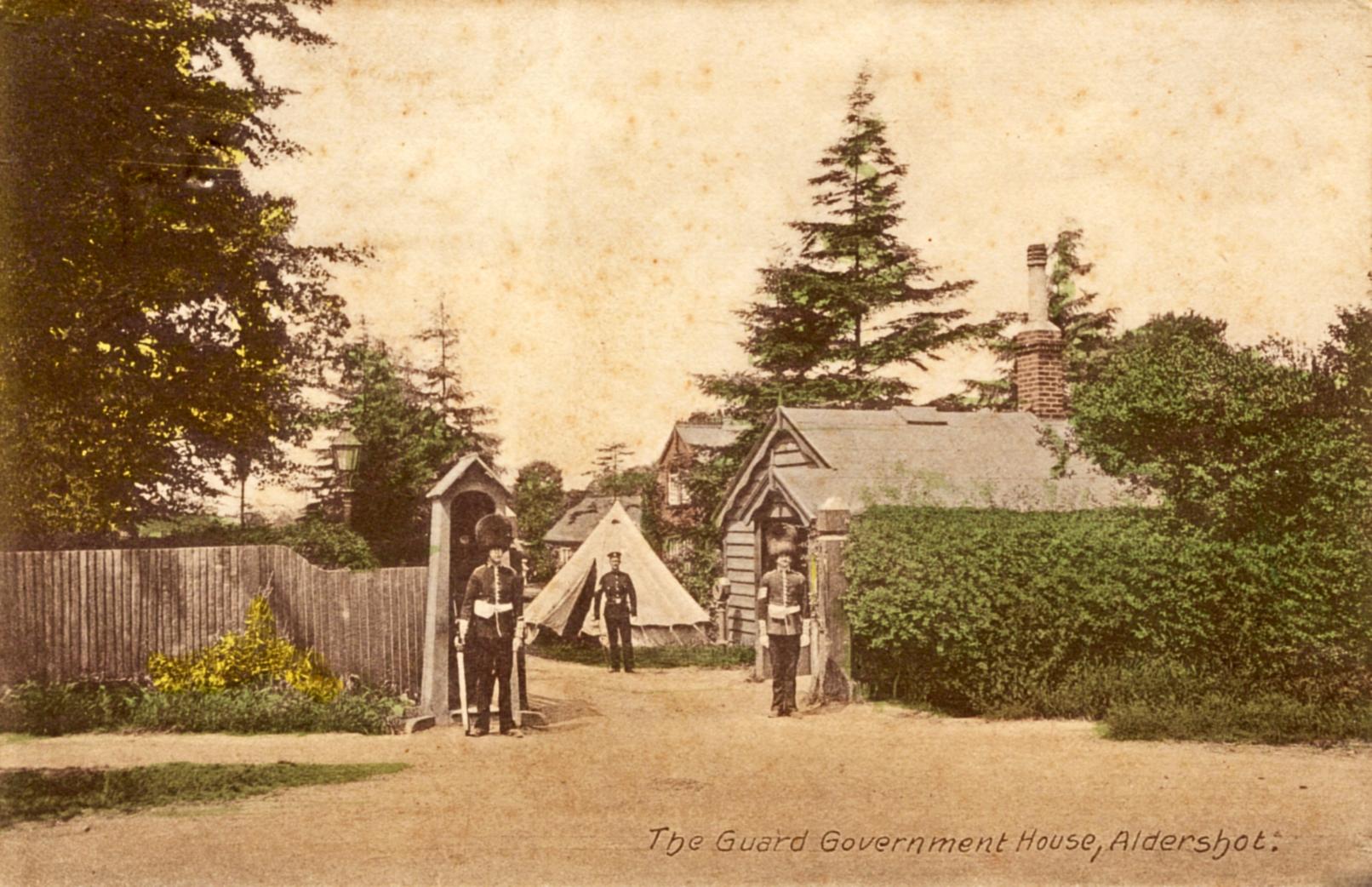
Separate from the main house but attached to it were the servants quarters, kitchen and offices. The house was set in 19 acres of grounds, complete with ornamental lake and grass tennis court. Also in the grounds were stables for 14 horses. The entrance was from Farnborough Road, where the gates were defended by sentries from a guardroom adjacent to the driveway.
The first GOC to live at Government House was General Sir Daniel Lysons, who had been GOC since 1880 and moved into the house in early February 1883. However, he did not remain long as he was replaced in August 1883 by Lieutenant General Sir Archibald Alison, who held the post of GOC until 1888. Alison was followed by Lieutenant General Sir Evelyn Wood (GOC 1889-1893) and General HRH the Duke of Connaught (GOC 1893-1898).
>The Duke of Connaught was the seventh of Queen Victoria’s nine children, and her third son. For a person of his rank, Government House was regarded as too small and cramped, so numerous additions and alterations were made. The London Evening Standard reported that “the Duchess took the greatest interest in these alterations, and most of the decoration and internal arrangements were those which her royal highness personally suggested”. During this time Queen Victoria would often stop to take tea with the Duke and Duchess when she made her regular visits to Aldershot. The Queen would arrive by train at Farnborough Station, then travel by carriage to Government House, before continuing on to the Royal Pavilion.
In 1901 the first Aldershot Military Fete was held in the grounds of Government House, over 25 and 26 June. The fete was opened by the Duke of Cambridge, and the VIPs were received by General Sir Redvers Buller, who was then the GOC, and his wife Lady Audrey Buller. Events included polo, gymkhanas, gymnastic displays, and instrumental music, along with numerous static stalls, and at night all the bands in the district combined for a torchlight tattoo. After expenses, the fete raised £1,100 in aid of the Soldiers’ and Sailors’ Families Association (worth around £127,000 in present day value).
>Despite the success of the fete, it was not repeated until 1904, but became an annual event thereafter. From 1907 the event was renamed the “Aldershot Military Tournament” and grew in size and popularity until by 1914 it was held over four days. However, this was the last of the Aldershot Military Tournaments as the First World War broke out two months later.
One reason for the gap in the fetes was a disaster which occurred during the bitterly cold night of 16 January 1903. Government House was then the residence of General Sir John French and his family. On this evening the general was away, but Lady French was dining with her son and daughter when around half past eight a servant noticed a fire in an attic room. Lady French and family were evacuated and given shelter in Churchill House, North Camp, while the garrison fire brigade tackled the blaze, assisted by the civilian Farnborough Volunteer Fire Brigade. A detachment of Grenadier Guards formed a chain to salvage valuable paintings, silver and furniture which were laid out on the lawn and protected by Military Police. The fire brigade was hampered by the freezing conditions, which were so cold that “all the firemen worked till ice clung to their uniforms”. By ten o’clock most of the fire was out, but all the building above the ground floor was destroyed. The government gave a grant of £5,000 to rebuild Government House, and the King allowed General French and his family to live in the Royal Pavilion until they could return to their residence.
Lieutenant General Sir Horace Smith-Dorrien took up appointment as GOC in 1907 and was not impressed by his new house. He remembered:
“One was provided with a bare house devoid even of fenders and curtain-poles. It cost me some £3,000 to fit up Government House at Aldershot, buy horses, etc … Government House [was] very limited in accommodation, and with great difficulty I persuaded the authorities to help me with material to build a squash-racket court and to add at government expense what they were pleased to call a ball-room; but as they cut off five feet from both the length and breadth of the design I submitted, they spoilt the ship for a ha’porth of tar.”
Smith-Dorrien was followed in 1912 by Lieutenant General Sir Douglas Haig, who was to play a prominent role in the First World War. Haig was at Government House at half past five in the evening of 3 August 1914 when he received a telegram containing the one word “Mobilise” and signed “Troopers”, the code name for the Secretary of State at the War Office. This dramatic moment marked Britain’s entry into the First World War. Haig wrote that the “orders were put in force and methodically acted upon without friction and without flurry”.
Government House remained the GOC’s residence until 1939 and the outbreak of the Second World War, when it became an officers’ mess, initially for the Canadian Army. After the war it continued as a mess for the higher command headquarters in Aldershot. At the time of the re-building of the garrison in the 1960s Government House was the South East District Headquarters Mess, and was one of the handful of historic buildings which survived. Its importance was recognised in 2002 when Government House was made a Grade II Statutory Listed Building.
By 2012 extensive work was needed both on the structure of the building and internally. Because of the historic nature of Government House this had to be done with great care, with the Army, Aspire Defence, English Heritage and Rushmoor Council all involved. The work was carried out by Rydon Maintenance Ltd and included underpinning the foundations; waterproofing the basement level; strengthening and re-slating the roof using vintage slates; changing parts of the internal layout to make better use of space; repairs to cornices, plasterwork, terrazzo mosaics and marble in the public spaces; restoration of the Queen’s Dining Room; and installation of a new kitchen. The project cost £2.5 million but was essential for maintaining the building for modern use.
Many great names have passed through the doors of Government House, and it is one of the most historic buildings remaining from the great Victorian camp.


Credits
Article originally published in the The Garrison, Autumn 2025
Copyright © Paul H. Vickers. This article, including the accompanying pictures, may not be reproduced or republished, in whole or in part, either in print or electronically, including on any websites or social media sites, without the prior permission of the author.